Reviews
Part of Home Printmaking Guide: Which Processes Fit a Home Studio
Home printmaking, tested against experience
Gouges, brayers, barens and bench hooks compared on the details that matter to a first-time buyer, with the marketing claims that mean nothing.
What to take away
- Home printmaking comes down to four purchases: a gouge, a brayer, a baren and a bench hook. The names a first-time buyer meets first are Speedball, Essdee, Pfeil, Power Grip and Takach Press.
- Buy two gouges you will use constantly rather than a boxed set of ten you will not.
- Brayer quality is decided by the roller compound and the frame, not by the handle.
- A wooden spoon prints as well as a cheap baren. A ball-bearing baren is the first upgrade worth paying for.
- Patent and design language on packaging says nothing about how a tool cuts.
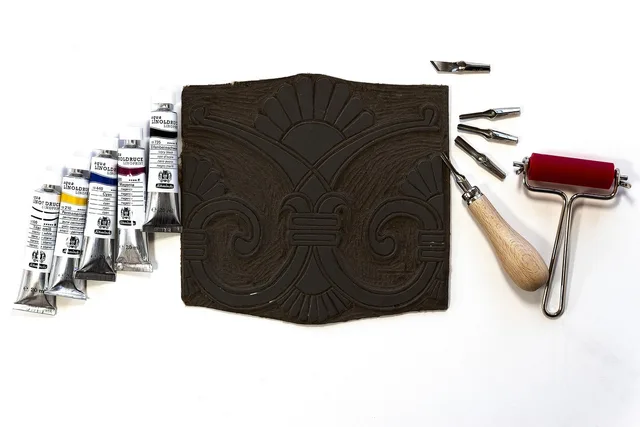
The four tools that decide the print
| Tool and named examples | What to check | What to ignore |
|---|---|---|
| Gouge: Speedball linoleum cutter, Pfeil 11 series, Essdee set, Power Grip from Mikisyo | Steel hardness, handle shape, whether it can be sharpened | Number of blades in the set |
| Brayer: Speedball soft rubber, Takach Press durometer brayers, Essdee | Durometer of the roller, frame rigidity, roller width | Color, branding, grip texture |
| Baren: Speedball plastic baren, Japanese ball-bearing baren from McClain's Printmaking Supplies | Bearing type, disc flatness, replaceable face | Weight alone |
| Bench hook: Speedball bench hook, Essdee bench hook, one cut from hardwood scrap | Whether it clamps or hooks, and its size | Timber species |
Roller durometer and ink behavior
- Soft roller (20-30 Shore A)lays more ink, suits open areas
- Hard rollerlays thinner film, holds fine detail
A soft roller, around twenty to thirty on the shore A scale, lays more ink and suits open areas. A harder roller lays a thinner film and holds fine detail. Most beginners buy one soft brayer and then wonder why fine lines fill in.
Speedball's soft rubber brayer is the usual first purchase, and its hard rubber version covers the other end of the range. Takach Press lists brayers by durometer number, so the same width can be ordered in a soft or hard compound.
Gouges and the sharpening question
A cheap gouge that takes an edge beats an expensive one you never sharpen. Test the steel on scrap linoleum: if the tool skates rather than bites, it is dull, not wrong. A Flexcut SlipStrop and a stick of Flexcut Gold compound cost about $30 together, less than one replacement gouge from Pfeil.
Speedball's linoleum cutter takes interchangeable cutters, numbered by shape and width. Pfeil stamps sweep and width on the handle, so a cutter you wear out can be reordered exactly. Power Grip tools from Mikisyo arrive sharp and hold an edge, at a higher price per tool.
Hand injuries in carving come from the block moving, not a dull tool. Clamp the block or use a bench hook so the cutting hand travels away from the holding hand.
Federal workplace rules on hand protection require gloves selected against the specific hazard present. That works at home: a cut-resistant glove on the non-cutting hand is chosen for that job, not bought as generic protection. Cut resistance is graded A1 to A9 under ANSI/ISEA 105, and the level is printed on the cuff.
Reading the packaging honestly
Tool packaging leans on words that sound like verified performance. Professional, studio grade and artist quality are not defined terms. Patent language is worth understanding, because a design patent under 35 U.S.C. 171 covers a new, original and ornamental design for an article of manufacture. It protects how a handle looks, not how the blade holds an edge.
The claims that do carry information are the measurable ones: roller durometer, steel type, blade width in millimeters, and whether spare parts exist. Pfeil prints the width in millimeters on the tool itself. Takach Press publishes a durometer number for every brayer it sells.
If a maker will sell you a replacement roller, the frame was built to outlive the roller. Speedball sells cutters and brayer rollers on their own, which is how you know the handle is meant to stay.
What to buy in what order
- One medium U gouge and one fine V gouge. A Speedball linoleum cutter handle with five cutters typically runs $13 to $18. A single Pfeil gouge typically costs $30 to $45 and outlasts several cheap ones.
- A brayer at least as wide as your usual block, in a medium durometer. A 4-inch Speedball soft rubber brayer is typically $20 to $30. Takach Press brayers start near $60.
- A sheet of plate glass or an acrylic slab as an ink plate. A 12-inch square of quarter-inch plate glass from a glazier is typically $15 to $35, and an acrylic offcut costs less.
- A bench hook, which you can make from scrap in twenty minutes. Speedball and Essdee each sell one for roughly $15 to $30.
- A ball-bearing baren, once you have printed enough to know your pressure. Speedball's plastic baren is about $10 to $20. A Japanese ball-bearing baren from McClain's Printmaking Supplies is typically $85 to $130.
Our starting point for a home practice explains why paper and ink outrank all of this, and the weekend practice plan puts each tool to work in a fixed order so you learn what each one actually changes.