Guides
Part of The linocut shortlist: projects worth cutting before you buy more gear
Carving out room for a linocut project on a shared table
Small-space setup for linocut projects: how to carve, ink and print relief blocks on a table you also eat at, including the pack-down routine and the eye protection.
What to take away
- A single board that lifts off the table turns any surface into a print bench and back again in a minute.
- Keep three zones on the boardcut, ink, and clean paper. Never let them overlap.
- Carving throws chips toward your face when a tool slips, so eye protection is a real requirement rather than a formality.
- Store paper flat and away from the kitchen. Humidity and cooking grease are both harder on a sheet than dust.
The lift-off board
Buy or cut a piece of stable board, around sixty by ninety centimeters (about 24 by 36 in), faced with laminate. That board becomes the studio. Mark three zones on it in permanent pen: carving at one end, inking at the other, and a clean strip along one long edge for paper.
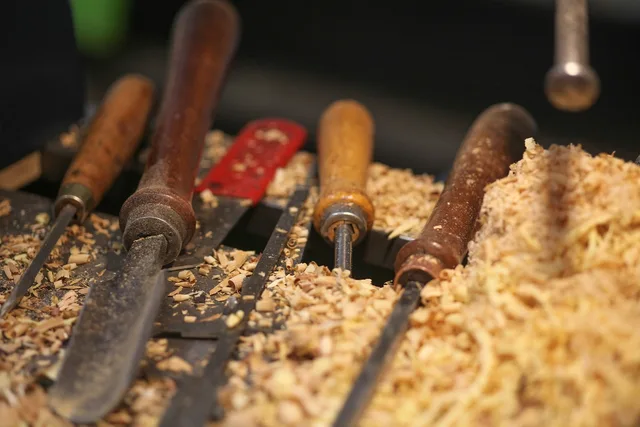
Everything else lives in one shallow box: gouges rolled in a cloth, brayer on its stand, water-based relief ink, tape, a small glass slab, a bench hook. The rule is that the box closes. If a tool does not fit in the box, the setup has grown past the space.
Pack down in a fixed order every time. Scrape and wipe the slab, wipe the brayer, cap the water-based relief ink, sweep chips into the bin, wipe the board with soap and water, close the box. The same soap and water keep the table safe for food. Six steps, four minutes.
Eye protection while carving
A gouge that skips out of a cut throws a chip of linoleum at speed, and it usually travels toward the face because that is where you are looking. OSHA 1910.133 says: eye and face protection is required where there is a hazard from flying particles, with side shields where objects can come from the side.
A pair of light safety glasses costs almost nothing and removes the only genuinely likely injury in relief printing that does not involve the blade itself. The second protection is a bench hook, which keeps the block still so the tool has less reason to skip.
Paper in a shared room
Small spaces mean paper competes with everything else for storage, and the wrong place ruins it. The US National Archives page on paper and parchment covers how these materials differ and what preserving papers actually involves. It is worth reading once because it separates the things that matter from the things that do not.
For a shared room, the short version is: flat, dark, boxed, off the floor, away from radiators, away from the cooker. A shallow underbed box is better than a shelf above a kitchen counter.
What fits and what does not
Fits a table
- Postcards
- Yes
- Pattern tile
- Yes
- Bookplate
- Yes
- Zine
- Yes
- Reduction print
- Tight
- Large floor block
- No
Notes
- Postcards
- Ideal small-space work
- Pattern tile
- Needs a straight edge, not space
- Bookplate
- The smallest useful project
- Zine
- Needs drying space, not bench space
- Reduction print
- Requires the edition laid out at once
- Large floor block
- Needs clear floor and a way to stand on the print
Our linocut project shortlist describes each of these in full, and the advice makers give about room layout applies at any scale, including a single table.
Keep the box packed for the room you actually have.