Features
Part of 4 points worth checking on home printmaking projects
Home printmaking projects: eight ideas and source choices
Home printmaking projects built around eight source-based ideas, with practical notes on choosing images and understanding copyright questions.
What to take away
- For home printmaking projects, choose source material you can use without asking anyone. It removes the only step that can stop a project cold.
- Two questions settle most source problemshow old is it, and who made it.
- Small, repeatable and finishable beats ambitious and abandoned.
- Fair use is a defense with a four-factor test, not a general permission slip.
Eight project ideas and their sources
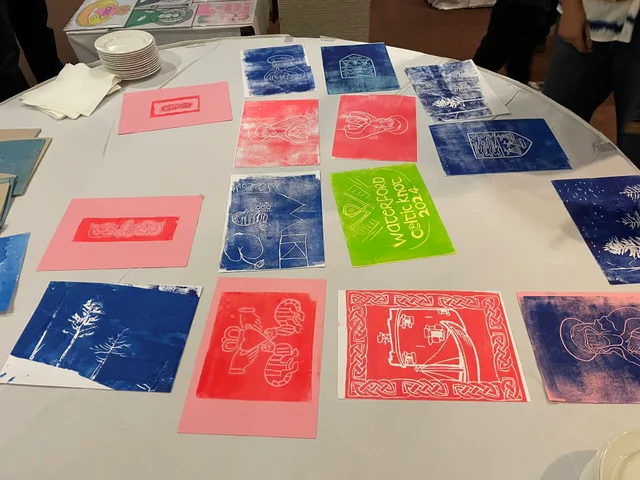
- A year of weather.One small relief block per month, the same format, printed on the same paper. Choose a simple weather symbol, sketch it, transfer it to a relief block, carve away the areas that should stay paper-colored, and proof with relief ink on scrap paper before printing. Teaches consistency more than any single ambitious print.
- Photograms of your own garden.Arrange garden objects on light-sensitive cyanotype paper, expose it to sunlight following the paper’s instructions, rinse it in water, and let it dry. No negative is required, and your own garden objects raise no image-rights question.
- A family document print.Choose papers and photographs you made or have permission to reproduce. Simplify the image, transfer it to a relief block, carve, ink, and print it.
- A found-lettering alphabet.Photograph signage as a reference, then carve letters you designed yourself or have permission to reproduce, one letter per block. Your photograph does not itself clear the rights to the lettering; proof the blocks on scrap paper before printing the alphabet.
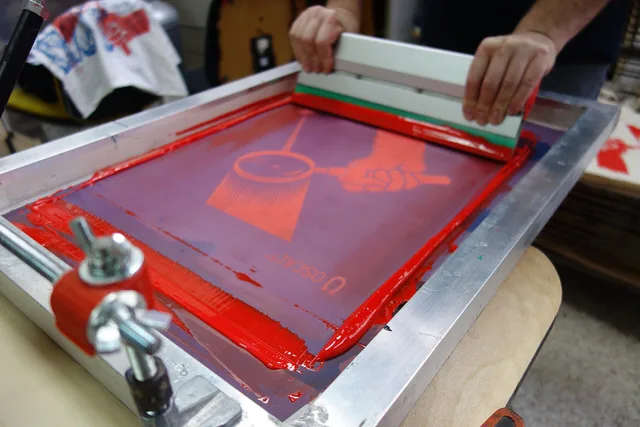
- A public domain reprint.Find a historic image in a collection with an item-specific rights notice confirming it is free to use. Transfer it into a relief, screen, or other print process, and keep a record of the source and rights notice.
- A neighborhood map.Draw a map from observation, make separate blocks or screens for its two colors, and align the layers when printing. Give the finished prints away.
- A recipe card set.Use a recipe you wrote or have permission to reproduce. Transfer the lettering in reverse to a relief block, carve it, proof it, and print the cards; the text-heavy work teaches lettering faster than any exercise.
- A collaborative exchange.Agree on the size, edition, and permission terms with the other printers first. Make and print your work, then swap it with the group.
Our shortlist of relief projects covers the technical side of several of these in more detail.
Eight domestic-room print projects
- A year of weathermonthly relief block
- Photograms of your own gardencyanotype
- A family document printown papers
- A found-lettering alphabet26 small blocks
- A public domain reprintconfirmed free
- A neighborhood maptwo colors
- A recipe card settext-heavy relief
- A collaborative exchangefixed edition
The two questions that settle a source
How old is it? Duration is defined by statute rather than by custom. For works created on or after January 1, 1978, copyright endures for the life of the author plus seventy years, with different terms for joint works and for anonymous, pseudonymous and made for hire works. For many works published before 1978, the Copyright Act’s rules in 17 U.S.C. § 304 make the publication date and renewal status relevant; unpublished works can follow different rules. Check the U.S. Copyright Office’s Circular 15A, Duration of Copyright, and Copyright Office records at copyright.gov rather than assuming an older work is in the public domain.
Settling a source's status
How old is it?
check the statutory term
assume protected
Who made it? If you made it, the question ends there. A work prepared by a U.S. federal government employee as part of official duties is generally not protected by copyright in the United States under 17 U.S.C. § 105, but an agency page may also show contractor or third-party material. Check the specific item record and the agency’s rights or permissions statement. If somebody else made it, you need permission, a license that covers your use, or documented public domain status.
| Source | Usual position | What to check |
|---|---|---|
| Your own photographs | Yours | Nothing |
| Objects from your garden | No image rights involved | Nothing |
| Federal agency photographs | Generally free of copyright | The specific item, not the collection |
| Family photographs | Depends who took them | Photographer, date, any studio |
| Anything found online | Assume protected | Everything |
For public-domain image searches, try the Library of Congress Prints & Photographs Online Catalog, Smithsonian Open Access, The Met Open Access, Rijksmuseum Collection Online, NYPL Digital Collections, and Wikimedia Commons. These collections include material with different rights statuses, so check the rights or usage notice for the individual item rather than treating the repository as a guarantee.
Creative Commons licenses have different terms. CC BY allows adaptation and commercial use with attribution; CC BY-SA adds a requirement to share adaptations under the same license; CC BY-ND allows redistribution only without adaptations; and CC BY-NC limits use to noncommercial purposes. Combined licenses add the corresponding conditions. CC0 is a public-domain dedication. For a print that changes the source, avoid ND licenses; for prints you plan to sell, avoid NC licenses.
Where fair use fits
Fair use is often misread as permission. It is a limitation set out in statute, and the fair use provision lists purposes such as criticism, comment, news reporting, teaching, scholarship and research, then sets out factors that must be considered, beginning with the purpose and character of the use.
The U.S. Copyright Office identifies the provision as section 107 of the Copyright Act, 17 U.S.C. § 107. Its four factors are: the purpose and character of the use; the nature of the copyrighted work; the amount and substantiality of the portion used; and the effect of the use on the potential market for or value of the work.
For a printmaker the honest reading is that fair use is decided case by case and after the fact, which makes it a poor foundation for an edition you intend to sell. Build projects on material whose status you know, and the question does not arise.
Finishing what you start
Pick one idea, set the edition size before you begin, and record the project the way our guide to documented projects describes. Finished small projects compound; unfinished ambitious ones do not.
Write the source line before you cut anything. One sentence naming where the image came from, recorded at the start, is what lets you sell or publish the result without reconstructing a decision from memory.