Guides
Part of 4 points worth checking on home printmaking projects
What learning route suits your stage of home printmaking?
Which learning routes suit which stage of a home printmaking practice, from books and courses to public image collections and printers you can work beside.
What to take away
- Different routes suit different stages. A book is wasted on week one and priceless in year two.
- Working beside another printer for one afternoon teaches more than a month of video.
- Public collections publish subject guides to large bodies of images. They are free, deep and underused.
- Learn the rights basics early. They take an hour and they change what projects you can finish.
Match the route to the stage
Best route
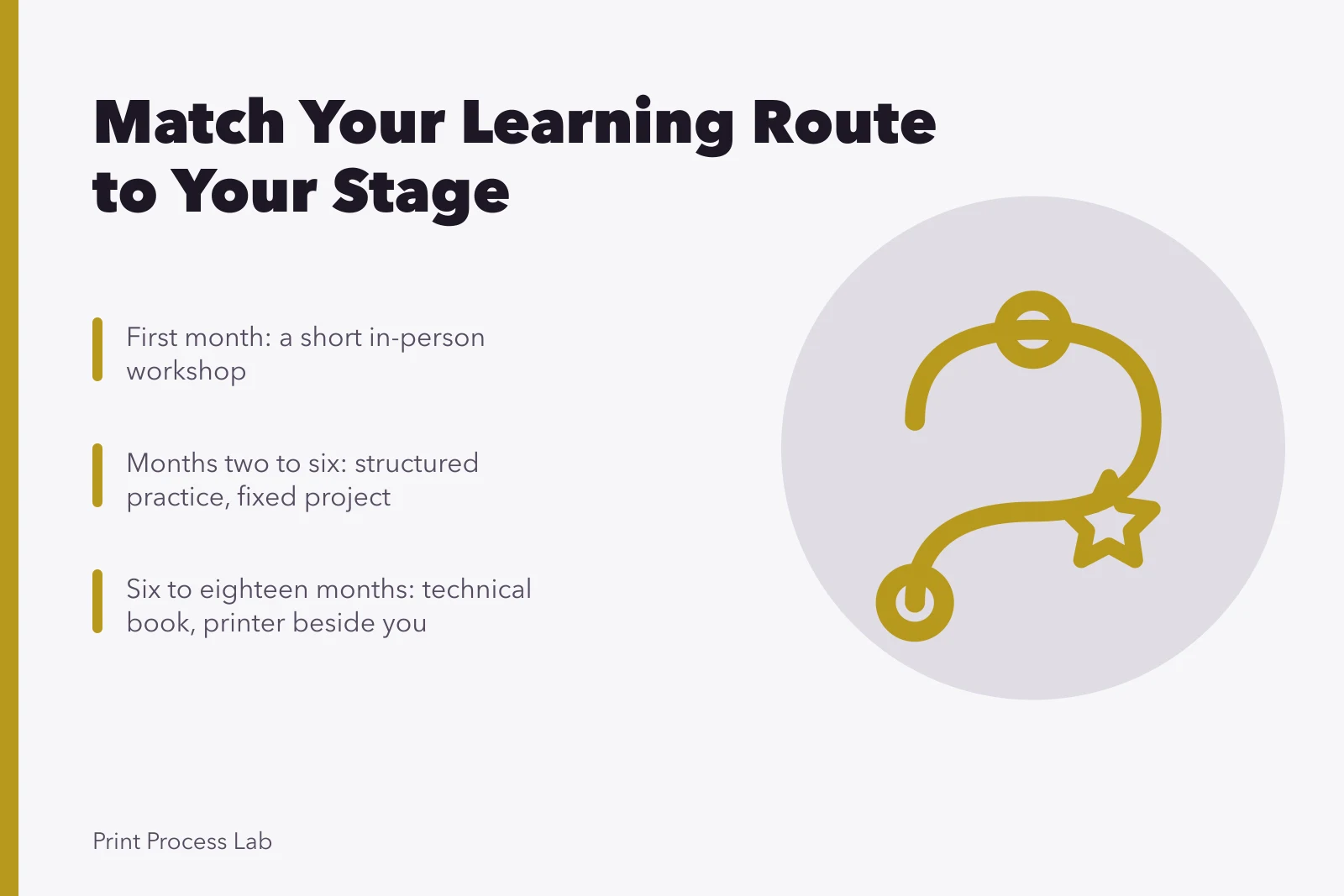
- First month
- A short in-person workshop
- Months two to six
- Structured practice with a fixed project
- Six to eighteen months
- A technical book, and a printer to work beside
- Beyond that
- Study rooms, conservation courses, teaching others
Poor route
- First month
- A technical book
- Months two to six
- Browsing tutorials
- Six to eighteen months
- More workshops
- Beyond that
- Watching from a distance
The most common error is staying in the workshop phase. Workshops are enjoyable and front-load the parts someone else already set up. Those are the parts you eventually need to do alone.
Route by stage
Stage
- First month
- Short in-person workshop
- Months two to six
- Fixed project practice
- Six to eighteen months
- Technical book, printer beside
- Beyond that
- Study rooms, teaching others
Best route
- First month
- Technical book
- Months two to six
- Browsing tutorials
- Six to eighteen months
- More workshops
- Beyond that
- Watching from a distance
Poor route
- First month
- Months two to six
- Six to eighteen months
- Beyond that
The test is simple: if you cannot repeat the session at home from your own notes, the learning has not transferred yet.
Work beside somebody
An afternoon next to a printer who works differently from you will change three habits. It is the highest-value learning available and it usually costs nothing but reciprocity.
Look for a person, not a venue. What you want is somebody who will let you watch them set up and clean down, because that is where the transferable knowledge lives. Our guide to finding classes and studios for a chemical process sets out how to judge a teaching space, and the same criteria identify individuals worth learning from.
Use public image collections
Large public collections publish subject guides that assemble tens of thousands of images around a theme, with the record group and identifier you need to find the original. The National Archives guide to photographs related to the Great Depression and the New Deal, for example, points into the holdings of several federal agencies from that period.
Two uses follow. Studying how photographs of a period were made and printed teaches process history faster than any survey. And federal photographs are a practical source of material to work from, provided you check the status of each specific item rather than assuming.
Learn the rights basics once
An hour on the basics saves years of hesitation. The Copyright Office maintains a plain general introduction to copyright that answers what copyright is and what it protects, and that is genuinely enough to start with.
As a printmaker, your own work is protected from the moment it is fixed.
Someone else's image needs permission or a clear public domain status, and an image is not free to copy. A technique is free to copy, and everything else can be looked up when a specific question arrives.
Our account of what documented projects reveal covers the recording habits that make any of this learning stick.
Change route when progress stalls rather than repeating the one that worked last time. Most plateaus mean the current route has given what it has, not that you have reached a limit.