
Guides
Where to Buy Printmaking Supplies in Canada Without US Customs Fees
Where to buy printmaking supplies in Canada without customs fees: the Canadian suppliers in Toronto, Vancouver and Montreal that price in CAD, plus what to check.
What to take away
- Buying from Canadian suppliers removes three costs at oncecurrency exchange, import duty and courier brokerage.
- Opus, DeSerres, Curry's and Above Ground cover most linocut, screen and monoprint needs in Canadian dollars.
- Ask about batch, shelf life and format before you ask about price.
- Store lino flat and inks above freezing, or sound stock fails early.
- Cross-border ordering still pays for a short list of specialist items.
Where the saving actually sits
A US list price is not the number that reaches your card. The charge arrives in US dollars, so the exchange rate moves it first.
Where the saving actually sits
- US list price
- Exchange rate moves it
- Duty by tariff line
- GST/HST on total
- Carrier brokerage per shipment
- Buying inside Canada removes each step
At the border, duty applies by tariff item under the Customs Tariff. GST or HST is then charged on the converted value plus duty. Carriers charge brokerage for clearing the parcel, and that fee belongs to the carrier, not the government.
The paperwork for importing goods into Canada is public. The shock is brokerage, charged per shipment rather than per dollar, so a small order can carry a fee larger than the goods inside it.
A typical courier brokerage fee on a parcel valued around CAD $120 runs about CAD $20 to $45, plus a small disbursement charge. Canada Post charges a handling fee near CAD $9.95 when duty or tax is owed.
Under the Courier Imports Remission Order and the Postal Imports Remission Order, the Canada Border Services Agency relieves duty and GST or HST on shipments valued at CAD $20 or less, with exceptions.
CBSA memorandum D8-2-16 sets out the courier rule and D8-2-17 the postal rule. Most real supply orders exceed that line, so the fee structure above applies to you.
Buying inside Canada removes each step. Provincial tax applies at the counter or at checkout, and a registered business can usually recover it, though which GST/HST rate applies depends on the province and the type of supply.
A cheap pack is not automatically good value. The finished cyanotype print cost breakdown uses different materials, but the arithmetic holds: a short shelf life raises the cost per usable sheet.
What to look for in a Canadian supplier
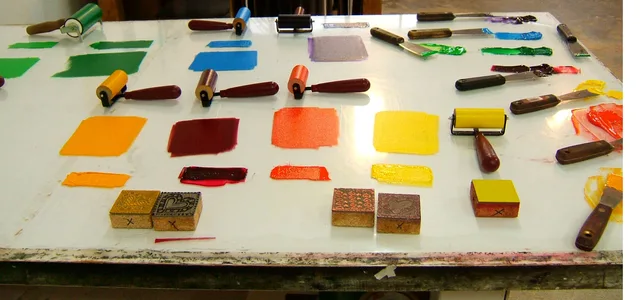
Stock depth matters more than a clean website. A shop that carries six grades of linoleum can answer a question about hardness. A warehouse listing one grade can only sell you what sits on the pallet. The staple list for relief work such as linocut barely changes between shops: blocks, brayers, ink, paper, gloves.
Canadian supplier types at a glance
Supplier type
- National art chains
- Toronto, Montreal, Vancouver
- Regional art stores
- Prairies, Atlantic, Vancouver Island
- Screen trade distributors
- Ontario and Quebec
- Paper merchants
- Toronto and Montreal
- Safety suppliers
- Every province
Where it is strong
- National art chains
- Lino, brayers, ink, paper
- Regional art stores
- Single sheets, small brands, advice
- Screen trade distributors
- Mesh, emulsion, squeegees, plastisol
- Paper merchants
- Rag papers, Mylar, cut-to-size
- Safety suppliers
- Nitrile gloves, respirators, solvents
What it carries
- National art chains
- Regional art stores
- Screen trade distributors
- Paper merchants
- Safety suppliers
Typical Canadian list prices, before tax, run as follows. A 10 x 15 cm unmounted linoleum block costs CAD $4 to $9. A 75 mm soft rubber brayer costs CAD $18 to $35. A 300 mL tube of water-miscible relief ink costs CAD $15 to $30. Prices vary by brand and city, so treat these as typical ranges.
Four chains cover most of the country. Opus Art Supplies serves British Columbia from Vancouver, with stores on the island and in the interior. Curry's Art Store covers southern Ontario.
DeSerres is the Quebec chain, with floors in Montreal and several Ontario cities. Above Ground Art Supplies in Toronto stocks relief and screen goods deeper than big-box stores do.
Opus, Curry's and DeSerres run online stores. Above Ground's deeper stock sits at its Toronto counter, so check shipping before you rely on a web order for screen goods.
Once you know which counter to visit, the printmaking workspace tool kit sets out what to buy on the first trip.
Questions for a supplier
Five questions decide whether a shop earns a repeat visit.
- Is this ink water-miscible or solvent-based?
- What is the batch number on this linoleum, and do you have more from that batch?
- How long has this stock sat on the shelf?
- Do you cut paper to size, or only sell full sheets?
- Is the shelf price in Canadian dollars with tax shown at checkout?
A store that cannot answer the batch and shelf-life questions is a fine source for gloves and rags. It is a poor source for a press blanket or a litre of ink.
Seasonality and availability
Canadian stock follows a school calendar. September brings the deep restock for printmaking courses, and January follows with inventory counts that leave shelves thin. Order in late spring or early autumn if you need a specific batch. If you buy in stages rather than one large haul, sequencing your cyanotype purchases shows how to spread orders across those windows.
Winter adds a shipping risk. Screen emulsion and some water-based inks do not survive a hard freeze. A parcel left on a depot dock in February can arrive separated or grainy. Ask for insulated shipping, or wait until March.
Ordering online outside the big three cities
Buyers outside Toronto, Vancouver and Montreal order most supplies online. Opus, Curry's and DeSerres ship by Canada Post or courier. A 2 kg parcel from Ontario to the Prairies or the Atlantic provinces typically costs CAD $20 to $35. Remote and northern addresses pay more, and oversize items such as press blankets or paper rolls may ship by freight.
Ask for the shipping total before you confirm. Many chains offer free store pickup, so a combined order can still beat a US parcel once brokerage is removed.
What labels tell you before you buy
Water-miscible is the label term that changes what you buy. On an ink label it means the ink can be thinned and cleaned with water while it is wet. It does not mean the dry film redissolves, nor that the product is hazard free. If you work in a small studio, pay for water-miscible ink and skip solvent.
Water-based and oil-based formulations behave differently on the plate, which is why the label matters more than the brand name.
Lightfast ratings in Canada remain manufacturer claims, not a regulated grade. Compare them within one brand. Do not pay a premium for a lightfast claim unless the maker lists a test method.
Storing what you buy
Storage decides how much of an order survives, so buy only what you can store flat and above freezing.
- Linoleum and rubber blocksflat, cool, out of direct sun.
- Water-based inksealed, above freezing, rim wiped.
- Photo emulsiondark, dry, room temperature.
- Paperflat, interleaved, off damp walls.
If you cannot store unmounted lino flat, buy mounted blocks. A printmaking materials storage guide covers the containers and dates worth keeping.