Reviews
Part of Why do printmaking mistakes keep happening, and how do you find the cause?
Printmaking mistakes: what to keep, isolate, and discard
Printmaking mistakes leave rejects and contaminated materials. Learn what to keep, what to isolate, how to handle spent solvents, and when to discard.
What to take away
- For printmaking mistakes, keep one labeled example of each fault. Discard the rest of the paper rejects at the scheduled cull, and route chemical waste through the appropriate hazardous-waste program.
- Isolate anything wet, moldy or contaminated before it reaches the main store.
- Spent cleaning solvents may be regulated hazardous waste, not general rubbish.
- Dry things out fast. Most damage from a wet incident happens in the days after it, not during it.
What to keep and what to lose
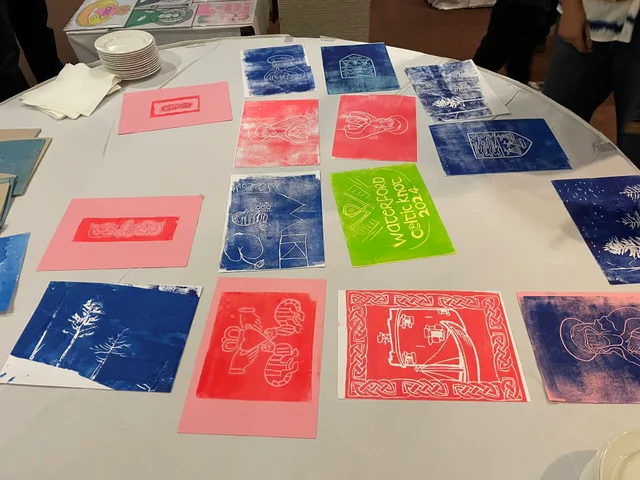
A reject pile grows without limit unless you set a rule. The rule that works is one example per fault, labeled with the fault name and the date, filed by variable. Useful labels include misregistration in screen or layered prints; unwanted plate tone and foul biting in etching; block slip and over-inking in relief; ink starvation or ink bleed in screen printing; and uneven exposure in cyanotype. Record the process and the variable that changed alongside the fault name. Everything else goes.
Keep or cull a reject
Is the fault explained?
keep one labeled example, cull the rest
keep until you explain it
Two exceptions are worth making. Keep good paper with a fault confined to one area—such as a small ink smear or a patch of uneven cyanotype exposure—because it can be cut down for tests. And keep any print that failed in a way you could not explain until you have explained it, or for one year, whichever comes first.
Set a date for the cull rather than doing it by feel. Once a month, take the reject pile to the bench, pull the one labeled example you are keeping, and clear the rest that day. A pile reviewed on a schedule stays small; a pile reviewed when it bothers you never gets reviewed at all.
Isolating contaminated material
Anything wet, stained, moldy or carrying an unknown residue is isolated first and assessed second. Put it in a separate box, in a different room from the main paper store, and label the box with the date and the reason.
Order matters with water. The National Archives lists recovery procedures for damaged records, drying the environment and the material. For a studio, cut room humidity before working on individual sheets.
Wet paper in a damp room grows mold in about two days. A moisture meter and pH pen are the fault-finding tools that show whether a sheet is worth drying.
Where spent solvents actually sit
Cleaning solvents are not automatically general waste when discarded. Under the Resource Conservation and Recovery Act (RCRA), the U.S. Environmental Protection Agency (EPA) lists certain spent solvents as hazardous waste in the F-list at 40 CFR 261.31 (F001–F005). Those listings depend on the solvent and the process that generated the waste; they do not mean every used studio cleaner automatically qualifies. Check the solvent's ingredients and use, as well as state and local requirements. The hazardous wastes from non-specific sources listing is the federal reference.
Household hazardous waste is generally excluded from federal hazardous-waste regulation, but state and local rules can still apply. A home-based studio should not assume that waste from business activity qualifies for the household exclusion; check with the relevant local agency.
- Keep spent solvent in its own labeled container, closed.
- Never mix solvent waste with water-based rinse.
- Never pour it down a drain.
- Take it to a household hazardous waste collection point, and ask before you arrive.
Vegetable oil can replace some petroleum-based cleaners for relief cleanup, but it does not eliminate every hazardous-waste stream. Handle oily rags and any leftover cleaning materials according to local disposal guidance.
Rags, blankets and cloths
Oil-soaked rags generate heat as the oil cures. Spread them flat to dry outdoors, or keep them in a sealed metal container. For solvent-soaked rags, use a compatible, closed, labeled container and follow the local hazardous-waste program's instructions; do not put them in ordinary trash.
Blankets and felts that have absorbed ink are worth washing rather than discarding, but wash and dry them flat and completely before storing. A damp felt in a closed cupboard is how mold starts.
Filing the fault reference
Keep the reference set in a labeled folder, flat, in the main store, interleaved and dry. It becomes a working document rather than an archive, so keep it where you actually stand.
Our taxonomy of print faults supplies the labels, and our guide to storing studio consumables covers the shelf-life and rotation side of the same problem.