Reviews
Part of Tracking what a member-run print studio needs heading into 2027
How to build shared studio benches that survive every user
Choosing shared benches that survive many users, defining what each surface is for, and the composite board question that affects the air in the room.
What to take away
- A shared bench needs a stated purpose written on it. Unlabeled surfaces become storage.
- Choose surfaces that survive being cleaned badly by strangers, not surfaces that reward careful owners.
- Composite panels can release formaldehyde, which is a regulated occupational exposure in its own right.
- Publish what each surface is for the way a service publishes what it does and does not do.
Design for the worst user, not the best
In a solo studio you can rely on your own habits. In a shared one, the surface has to survive somebody wiping ink off with the wrong solvent at the end of a long session.
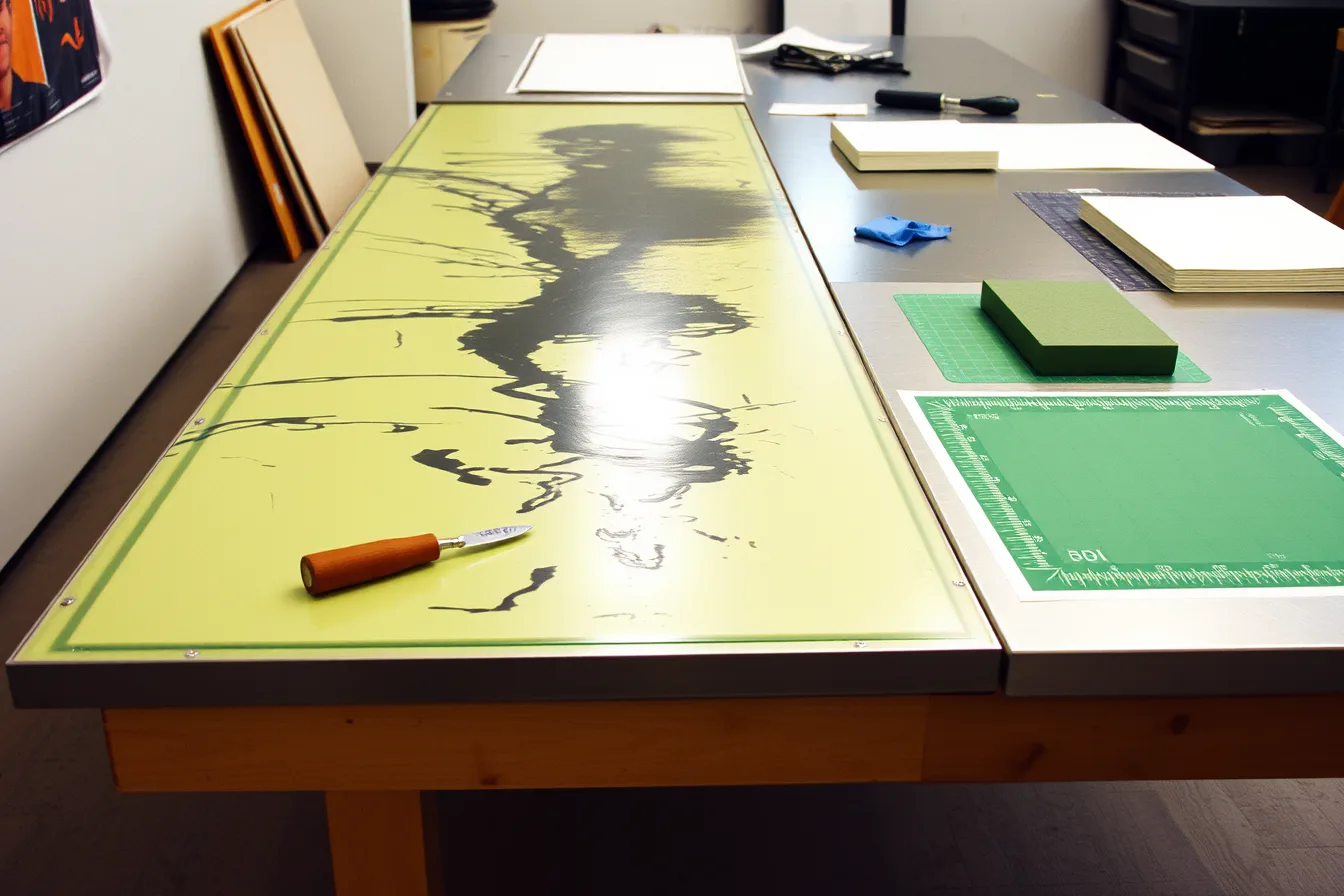
That points to a narrow set of materials: high pressure laminate, toughened glass, stainless steel and sealed concrete. All four tolerate water, most cleanup solvents and repeated scrubbing, and can be assessed at a glance for cleanliness.
That matters when the next person needs to know whether the bench is ready. Choosing materials for an independent print studio starts with the same short list of surfaces that tolerate solvent and scrubbing.
Avoid oiled timber and anything with an exposed particle-board edge. Both absorb, both stain, and neither can be honestly declared clean.
Say what each surface is for
Label every bench with its purpose and its cleaning rule. Wet bench, ink bench, clean paper bench, cutting bench. Four labels remove most of the arguments a shared studio has.
Public facilities do this as a matter of course. The National Archives publishes what its preservation labs actually provide as services: consulting, work for offices across the agency, and participation in the wider professional community.
Stating scope explicitly lets other people use a facility correctly. A bench label is the same idea at a smaller scale.
The composite panel question
Studios build benches from what is affordable, often composite panel. Some composites release formaldehyde. Occupational exposure is regulated on its own: the federal standard covers exposure from formaldehyde gas, its solutions and materials that release formaldehyde and sets an action level as an eight-hour average concentration.
Formaldehyde rules are one example of the paperwork a new shared print studio needs before anyone signs a lease.
The studio is not running an exposure monitoring program, but the practical response is easy. Choose low-emission panel products when you can, and seal cut edges instead of leaving raw board exposed.
Ventilate the room well for the first weeks after new benches go in. If the room smells of new board, use air, not air freshener.
A workable bench plan
| Bench | Surface | Cleaning rule |
|---|---|---|
| Wet | Laminate or stainless, coved edge | Rinse and wipe after every use |
| Ink | Glass over laminate | Scrape, then wipe, then leave clear |
| Clean paper | Laminate, nothing stored on it | Wipe before use, never after |
| Cutting | Replaceable mat on laminate | Blades away, mat swapped annually |
Our review of work surfaces for a home print room compares the same materials for a single user, and our studio watchlist puts bench condition on a review schedule alongside everything else.
Review benches on the same schedule as the machines. A surface degrades slowly enough that regular users stop noticing, which is why the check has to be a date in a calendar rather than a judgment call made by whoever happens to be in the room.
Common questions
How often should shared benches be resurfaced? When a straight edge shows a gap, or when stains start transferring. Both are visible tests.
Should surfaces be color coded? Yes, if the studio uses a color scheme elsewhere. Consistency matters more than the specific colors.
Is stainless steel worth the cost? For a wet bench in a busy studio, often yes, because it survives everything and cleans in seconds.
Who is responsible for leaving a bench clean? The last user, named in the house rules. Anonymous responsibility is no responsibility.