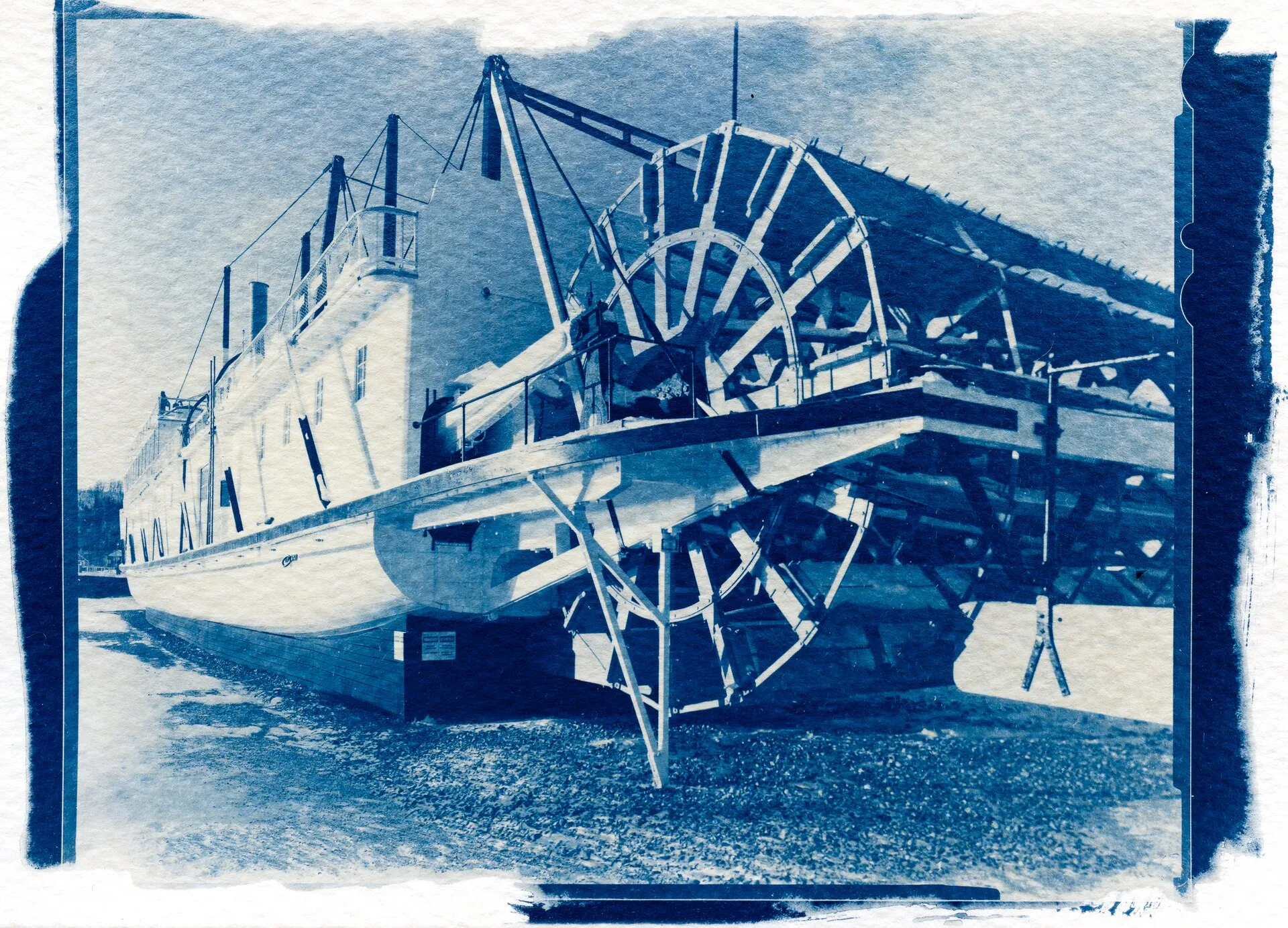
Costs
Part of The cyanotype process: chemistry and safety rules
Does a finished cyanotype print really cost what you think?
A finished cyanotype print carries paper, film, chemistry, failures and framing. Here is where the money goes and when a reproduction is cheaper.
What to take away
- A finished cyanotype print carries four costspaper, sensitizer, negative and failures. Paper usually dominates at 80 to 95 percent of the per-sheet total.
- Sensitizer for one 8x10 sheet runs a few cents. Good cotton rag paper costs $1.50 to $6.00 per sheet, depending on brand and size.
- An 8.5x11 inch digital negative on Pictorico or Fixxons film costs roughly $2 to $4 printed at home. It serves the whole edition.
- Cost per finished print is cost per sheet times the number of sheets per keeper. A $3 sheet at one keeper in three is $9 before chemistry.
- A finished 16x20 cyanotype on cotton rag typically costs $14 to $40 in materials at one keeper in three. Framing and shipping sit on top.
- Framing and glazing routinely exceed the material cost of the print itself.
Where the money goes
Four buckets carry a cyanotype edition, and they behave differently.
| Bucket | Items | How it behaves |
|---|---|---|
| Paper | Cotton rag sheet | Scales with every sheet coated, including rejects |
| Sensitizer | Cyanotype kit chemistry | A few cents per sheet, fixed per sheet coated |
| Digital negative | Inkjet transparency film, ink | Fixed per image; falls per print as the run grows |
| Failures | Rejected sheets, lost time | Multiplies paper and chemistry through the keeper rate |
Cyanotype cost buckets
- Per sheetpaper 80-95%
- Per imagedigital negative, film, ink
- Per sessiongloves, wipes, cleaning
- Amortizedtrays, glass, lamp, scale
The negative is the item people forget. A single transparency costs more than the chemistry for several prints, but it serves an entire edition, so its cost per print drops as the run grows.
At $2 to $4 per 8.5x11 negative, the negative adds about $0.40 to $0.80 per print in a run of 5, $0.10 to $0.20 at 20, and $0.04 to $0.08 at 50.
Typical US prices as of 2026 for the main inputs:
| Item | Named examples | Typical cost |
|---|---|---|
| Cotton rag paper | Arches Aquarelle, Bergger COT 320, Hahnemuhle Platinum Rag | $1.50 to $6.00 per 8x10 sheet |
| Sensitizer | Bostick & Sullivan Cyanotype Kit, Photographers' Formulary Cyanotype Kit, Jacquard Cyanotype Set | $15 to $40 per kit; a few cents per sheet |
| Digital negative film | Pictorico PRO Ultra Premium OHP, Fixxons Waterproof Inkjet Film | $30 to $45 for 20 Pictorico sheets; $50 to $80 for 100 Fixxons sheets |
| Ink | Epson UltraChrome or Canon Lucia pigment ink | $30 to $120 per inkset; $2 to $4 per 8.5x11 negative with film |
| UV lamp | Bostick & Sullivan UV LED unit, used NuArc plate burner | $250 to $1,200 new; $300 to $1,500 used |
| Vacuum frame | DIY vacuum frame, used contact frame | $150 to $600 |
| Drying rack | Stackable screen rack | $15 to $40 |
| Framing | Ready-made 16x20 frame, custom frame with museum glass | $20 to $50 ready-made; $80 to $300 custom; glazing $60 to $150 |
| Copyright registration | U.S. Copyright Office electronic filing | $45 to $65 |
| Archive reproduction | National Archives still picture service | Often $20 to $100+ per image |
Count the failures honestly
Cost per sheet coated is not cost per finished print. A beginner keeps one usable print for every two or three coated, and that rate improves once exposure is calibrated.
Failure rate math
$9 per finished print
A $3 sheet kept one in three
Test strip removes most rejects
Pays for itself first session
The arithmetic: if a sheet costs S and you keep one in K, cost per finished print is S x K. A $3 sheet at one in three is $9 before chemistry. A test strip costs a fraction of a sheet and removes most of the rejects, which is why it pays for itself on the first session.
A worked total for a 16x20 on cotton rag: paper at $6 a sheet kept one in three is $18. Chemistry across those three sheets is under $1, and a 16x20 negative at $5 to $10 adds $2 to $4 per keeper.
A ready-made frame at $35 brings the first finished print to roughly $55 to $60. A run of 20 unframed keepers at this rate is about $400 to $500 in materials, and the negative is shared across all of them.
The wider method for building supply figures without inventing prices is set out in our overview of printmaking supply costs, which lists how to record a sheet price, keeper rate and run length.
Equipment that changes the numbers
A UV lamp is the main equipment decision. It does not make better prints; it makes the same print at the same exposure regardless of the season. Value it as a reduction in the failure rate rather than as an improvement in quality, and it becomes easy to judge whether you need one yet.
A vacuum frame is a further step, worth it only for large prints where glass alone will not hold contact. A drying rack is cheap and matters more than either.
When buying beats making
For historical or documentary images, a reproduction from an institution is sometimes cheaper and better than making one. Archives publish what they hold and how to request copies: the National Archives explains its still picture reproduction service, including the record group, series and item citation you need before an inquiry can go anywhere.
One comparison for the same image: an archive reproduction runs $20 to $100 or more. Making an unframed 16x20 yourself lands near the worked total of $20 to $25 in materials, with the negative and the keeper rate included.
A reproduction also settles rights. The Copyright Office notes that registering your own work takes a completed form, a nonrefundable filing fee and a nonreturnable deposit, so the fee is published rather than quoted. The electronic fee runs $45 to $65 as of 2026, and paper filings cost more.
The costs outside the studio
- Framing and glazing, which frequently exceed the print's material cost. Prices for ready-made and custom frames are in the table above.
- Packaging and postage if you sell. A rigid mailer and tracked shipping typically add $8 to $20 per print.
- Registration, if you protect an edition. U.S. Copyright Office electronic filing is $45 to $65, with a nonreturnable deposit.
- Water, trivial per print and noticeable if you run a tray under a tap for an hour.
Our account of the process itself explains which of these steps you can shorten without hurting the print.
Common questions
Is cyanotype cheap?
Cheaper than most alternative processes, and dominated by paper rather than chemistry. A 4x5 test strip costs pennies; the finished 16x20 on cotton rag is where the money sits. A 16x20 cotton rag sheet typically runs $4 to $12, and a custom frame adds more than the print materials.
Should I buy paper in bulk?
Once you have settled on one. Before that, buy small packs of several papers and test, because a paper that shifts tone under your water will waste the whole ream.
How do I price a print for sale?
Materials, plus failure rate, plus time, checked against comparable work. Materials alone always underprices, and the failure rate is the term most people leave out. A typical studio rate of $20 to $50 per hour for coating, exposure, washing and spotting is the number most makers omit.