
Industry
Part of The cyanotype process: chemistry and safety rules
Cyanotype process: negatives, toning and limited editions
A practical cyanotype process guide: making digital negatives, toning with tannins, and signing and numbering a limited edition, with the U.S. copyright rules.
What to take away
- The negative does most of the work. Makers spend more time on negatives than on coating.
- Toning is a second process with its own chemistry, not a filter applied at the end.
- Sign and consecutively number a limited edition. The Copyright Act, through the Visual Artists Rights Act, attaches specific rights to editions built that way.
- Keep a session log. Cyanotype varies with the weather, and only a log makes a result repeatable.
Negatives come first
Almost every working cyanotype process runs on digital negatives printed onto inkjet transparency film, because a cyanotype needs a negative the same size as the finished print. The film matters: use a sheet made for the purpose, such as Pictorico OHP; ordinary overhead film beads the ink and prints uneven density. The variable that matters most is density range. A negative that looks correct on screen is usually far too thin for a process that needs a long scale.
Makers build a correction curve once, for their own printer, ink and film, then reuse it. The usual method is to print a step wedge through that printer and film, read the patches with a transmission densitometer or a flatbed scanner, and build the curve from those readings in an image editor. That single calibration removes most of the frustration people attribute to the chemistry.
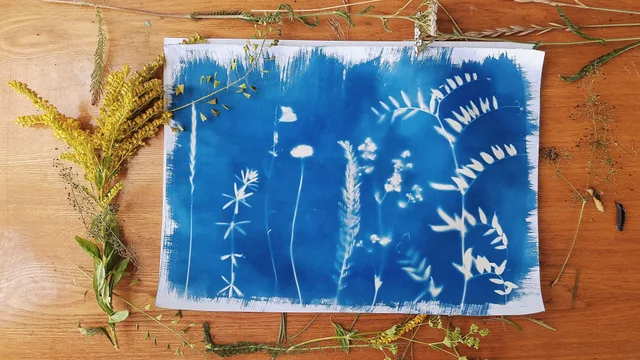
The alternative route is objects. Photograms made by laying plants, fabric or cut paper directly on the coated sheet need no negative at all, and many independent practices are built entirely on that.
Underneath all of it sits the same two-part sensitizer: ferric ammonium citrate and potassium ferricyanide, coated onto the sheet. Neither part is exotic, and the cyanotype process is forgiving about technique and unforgiving about consistency, which is why the notes matter as much as the negative.
Toning as a deliberate second stage
Cyanotypes can be shifted away from blue by bleaching in an alkaline bath — sodium carbonate (washing soda), borax or a proprietary cyanotype bleach — and then toning in a tannin solution, which produces browns and purple-browns depending on the tannin and the timing. Tannic acid is the controllable option; strong green tea, coffee and rooibos are the everyday alternatives, and pyrogallol is the classic historical toner. Treat it as a separate process with its own tests, its own trays and its own notes.
Two cautions. Bleaching is the step that can go too far in seconds, so work in dilute solutions and watch the print rather than the clock. And any alkaline bath must be kept away from prints you want to stay blue.
Editions, signatures and the rights that follow
Independent makers usually work in editions, and how an edition is built has legal consequences. The Copyright Act defines a work of visual art in 17 U.S.C. § 101 to include a print in a single copy or a limited edition of 200 copies or fewer.
That print must be signed and consecutively numbered by the author. The definition separately includes a still photographic image produced for exhibition purposes only, on the same numbering and signing terms.
Where a work meets that definition, the author gains the moral rights set out in section 106A, added by the Visual Artists Rights Act (VARA). These include the right to claim authorship and to prevent intentional distortion or modification that would prejudice the author's honor or reputation.
Which category a cyanotype falls into is a question for a lawyer. Both routes depend on the same habit: keep the edition limited, sign it, and number it consecutively.
Registration is a separate step, and it is the one that leaves a paper trail. Register the edition with the U.S. Copyright Office; its visual arts application covers prints and photographs and asks for the same edition and numbering information your log already holds. Registration is also what lets you bring a suit over the work in a U.S. court.
What a session log records
- Date, time of day, and sky condition or lamp hours.
- Paper, batch, and whether it was buffered or not.
- Sensitizer age and coating method.
- Exposure time and the test strip result.
- Wash duration, water temperature, any acid rinse.
Read it back before the next session. Our guide to photographing and captioning finished prints covers how to keep the visual record alongside the written one, and our account of how cyanotype works explains which of these variables actually moves the result.
Print a control strip alongside every batch, from the same coating, exposed the same way. Cyanotype drifts with the weather, and a control strip is the only thing that tells you whether a difference belongs to the print or to the day.