Industry
Part of The linocut shortlist: projects worth cutting before you buy more gear
5 lessons worth learning about linocut project ideas
How independent relief printmakers choose projects, build a recognizable body of work, and handle the naming and rights questions that come with selling.
What to take away
- Independent makers treat linocut project ideas as series, not single images: fifteen pulls of one subject, one format, one edition size, one year. The series is what people recognize.
- Constraints come firstone paper, one block size, a three-ink palette plus transparent base, a fixed edition size, one exclusion rule. Choice slows production more than technique does.
- Pick a block for the joba reduction print carries three colors on one block, a multi-block print uses Ternes Burton pins, a repeating tile prints with Speedball Fabric Block Printing Ink.
- Simple word logos and common symbols such as hearts may fall outside copyright, which matters if a studio name is doing the work of identification.
- Give the series an end date and a public event, such as Print Day in May or PrintAustin.
Lesson 1: Print the same subject fifteen times
Ask working relief printmakers how they choose projects and the answer rarely concerns a single image. They set a frame: fifteen prints of one subject, one format, one edition size, one year. The frame removes the daily question of what to make and turns attention onto the making.
A series survives contact with an audience better. Somebody who likes one print looks for the next, and a coherent group is easier to show, price and photograph than a scatter of unrelated pieces.
Print Day in May, held on the first Saturday in May since 2007, gives the group a deadline. PrintAustin, a print festival in Austin, Texas, runs each January.
Lesson 2: Pick a subject with twelve versions
Choose a subject that supplies its own calendar: one native plant per month, one street corner per month, one bridge from twelve angles.
A monthly plant series suits carvers who like detail. Pfeil gouges, made in Switzerland, typically cost $30 to $50 each, and a 1 mm V-gouge handles fine stems.
Paper choice sets the tone. Awagami Factory in Tokushima, Japan, makes kozo papers that relief printers use. Legion Paper's Stonehenge and Canson's BFK Rives, both 250 gsm, typically cost $2 to $5 a sheet. Blick Art Materials and Jackson's Art Supplies stock all three.
Lesson 3: Try a three-color reduction print
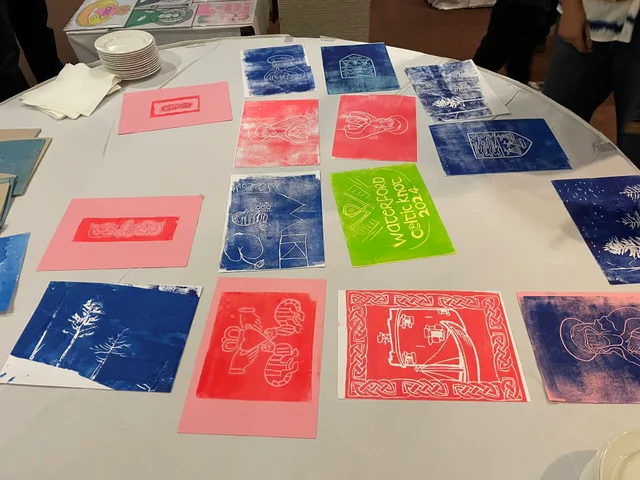
A reduction print uses one block for every color: cut, print the edition, cut again, print over the first color. Nothing can be reprinted, so the edition size is fixed at the start.
Speedball Speedy-Carve blocks, made in Statesville, North Carolina, cut with less resistance than gray battleship lino. Graphic Chemical and Ink in Villa Park, Illinois, sells 12 by 12 inch sheets, typically $8 to $15 each.
Cranfield Colours of Wales makes Caligo Safe Wash relief ink, which cleans with soap and water. A 75 ml tube typically costs $10 to $15. A basic Speedball linoleum cutter set runs $15 to $25, and a 4-inch rubber brayer $10 to $18.
Lesson 4: Carve a tile that repeats
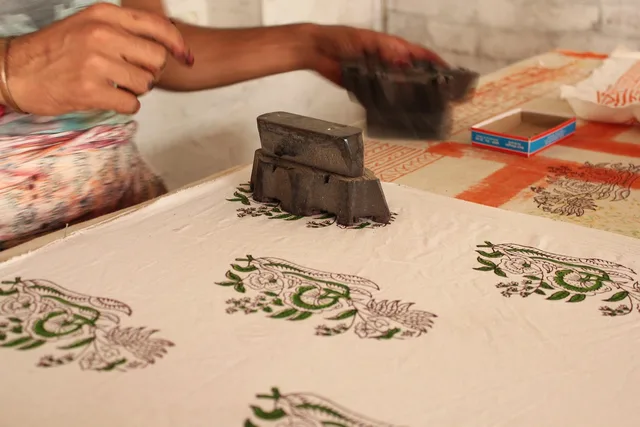
Cut a 3-inch square that tessellates and one block prints yardage. Speedball Fabric Block Printing Ink, about $6 to $10 for a 1.25 oz jar, bonds to cotton after heat-setting with an iron.
Test the repeat before a long run. Fold the print, match the edges, and recut anything that breaks the grid. Ternes Burton registration pins, sold in starter packs of $20 to $40, hold a second color in line.
Lesson 5: Make a small edition for markets
A6 cards measure 4.1 by 5.8 inches, and a run of 30 to 50 covers a market table without months of cutting. Ex libris bookplates, printed with the owner's name, take custom orders and ship flat.
One 4 by 6 inch block fits both. Order paper in pads that size from Blick Art Materials or Jackson's Art Supplies.
Constraints that experienced makers use
- One paper for the whole series, so the results are comparable.
- One block size, so storage and framing stay simple.
- A palette of three inks plus transparent base.
- A fixed edition size decided before the first pull.
- A rule about what does not go inno text, or no faces, or no more than two colors.
The size rule produces the most work. It removes the decision that eats the most time before cutting starts. Mixing Caligo Safe Wash with transparent base stretches a 75 ml tube across a larger edition.
Constraints for a Series
- One paper for the whole series
- One block size for storage
- Three inks plus transparent base
- Fixed edition size before first pull
- A rule about what does not go in
What copyright actually covers here
The Copyright Office explains that copyright protects original pictorial, graphic and sculptural work, where original means independently created and sufficiently creative. Common symbols such as smiley faces and hearts, along with typography, are not eligible. Very simple works, including stylized word logos and minimalist pieces, may also fall outside protection.
What Copyright Covers
Protected
- Originality
- Independently created
- Creativity
- Sufficiently creative
- Examples
- Real compositional decisions
- Simple works
- Signed and dated series
Not Protected
- Originality
- Common symbols
- Creativity
- Typography
- Examples
- Smiley faces, hearts
- Simple works
- Stylized word logos
A print built on one common symbol is weakly protected. A series with real compositional decisions is not. Sign and date work, and keep the dated files that show when each image was made.
Naming a studio
Because a very simple word logo may not be protectable by copyright, makers often rely on the studio name itself for recognition. The federal guidance on what makes a trademark strong is the clearest short explanation available.
The guidance is simple: a mark works better when it is inherently distinctive, which means it identifies the source quickly rather than describing the goods.
A name like Relief Print Studio describes what you sell and does little else. An invented or arbitrary name does more work. Registration is a separate decision, but a descriptive name closes off options early.
Turning a project list into a body of work
Pick three projects from our shortlist of linocut projects that share a constraint, and run them as one series rather than three experiments. Our guide to finding classes and studios covers what separates a teaching space worth paying for from a room with equipment.
Penland School of Craft in North Carolina, Anderson Ranch Arts Center in Colorado, and Haystack Mountain School of Crafts in Maine run week-long relief workshops, typically $700 to $1,500 plus room and board. Women's Studio Workshop in Rosendale, New York, offers residencies with press access.
Set an end date as well as a size. Work without a deadline expands until it stops being a series and becomes a habit with no output.