Reviews
Anthotype Prints Without Spinach: Testing Everyday Plant Pigments at Home
Testing beet, turmeric, berry and petal emulsions against spinach, with fade rates, a one-day test and coating tips for anthotype prints at home.
What to take away
- Turmeric and beet fade within hours in full sun, so they suit quick silhouette tests rather than detailed negatives.
- Blueberry, red cabbage and pansy petals hold color for several days and give the longest tonal range.
- Spinach chlorophyll sits between those extremes, which keeps the spinach method a dependable baseline.
- Paper choice and sizing affect edge sharpness more than the pigment itself does.
Why spinach became the reference point
Spinach is cheap, sold year round, and gives a dense green coat. It fades at a steady rate, so a beginner can read exposure without guesswork. The anthotype process works with light-sensitive plant juice rather than one special plant. Chlorophyll is not the most lightfast pigment in a garden, yet it is the most predictable.
When you want the full workflow, the spinach juice anthotype method sets out exposure times, paper choices and USD costs for US makers.
Pigments from the kitchen and garden
I tested six pigments over one July in a south-facing yard. Every strip used the same paper, the same brush and the same two coating passes. Only the pigment changed.
Berries mash with a fork. Leaves need a blender and a strain through muslin. Spices steep in hot water and cool before coating.
| Pigment | Kitchen or garden source | Fade speed in full sun | Best use |
|---|---|---|---|
| Turmeric | ground spice steeped in hot water | fastest, often under two hours | proving a positive works |
| Beet | grated root, strained | fast, half a day to one day | bold silhouettes |
| Spinach | fresh leaves, blended | medium, one to two days | balanced contrast |
| Pansy petals | fresh blooms, crushed | medium, two to three days | soft floral tones |
| Blueberry | frozen berries, mashed | slow, three to seven days | long tonal prints |
| Red cabbage | shredded leaves, simmered | slow, three to six days | blue violet images |
Turmeric surprised me most. Its yellow left before lunch on day one and only a pale stain remained. Blueberry juice stained the paper deeply and kept its tone for a week.
A pigment that loses half its color in two hours cannot hold a detailed negative. Match the pigment to the image you plan to print.
How to run a fade test in one afternoon
- Cut six strips of cold-press watercolor paper, each about 5 by 15 cm.
- Coat each strip with one pigment, using the same brush and the same two passes.
- Dry the strips in a dark drawer, then mask half of each strip with card and tape.
- Tape all six strips to a board and set the board in direct sun for one day.
- Record the hour when each pigment loses half its color.
Checks before the first exposure
- Pigment strained through muslin, with no pulp left in the bath.
- Paper sized and fully dry before coating.
- Negative or plant material pressed flat against the coat.
- A dark folder waiting for the finished print.
Coating paper so the emulsion holds
Bare watercolor paper drinks juice unevenly, and thin patches bleach first. A light size fixes that. Gelatin sets firm at room temperature and can be melted again for a second coat. Brush one warm layer over the sheet, let it dry, then coat with plant juice as usual.
Example: a beet contact print in two days
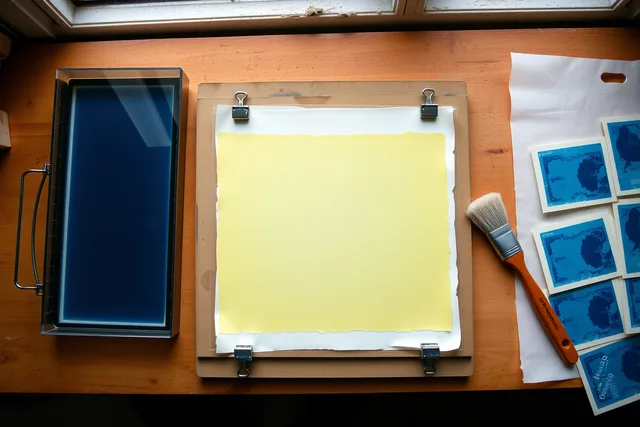
I pressed a fern frond onto beet-coated paper and clamped it under glass. Day one of full sun gave a soft edge. Day two finished the image, with the frond reading pale against magenta. Beet needs a heavy coat, because thin coats vanish before the shape appears.
Timing exposure to summer sun
Sun printing covers the wider family of plant-based processes, and anthotypes sit inside it. Direct midday sun in June and July does the work in hours. Cloud cover stretches that to several days. A UV index of 8 or higher is a good day to start.
Cleanup and leftovers
Leftover juice belongs in a compost bin. Do not pour thick spice slurry down a sink, because it settles in the trap. Plant pulp and strained solids break down quickly. Keep the work area away from food preparation while juice is open.