Guides
Selling Linocut and Screen Prints into Canada: Customs, GST and Labeling
Selling linocut and screen prints into Canada means HS 9702 duty free treatment, bilingual textile labels, and GST or HST registration above CAD 30,000.
What to take away
- Hand-pulled prints enter Canada under heading 9702 and normally clear duty free.
- Commercial reproductions fall under heading 4911, where duty varies by subheading.
- Screen printed textiles need bilingual English and French fiber and care text.
- GST is 5 percent and Ontario HST is 13 percent; registration usually starts past CAD 30,000 in Canadian sales over four quarters.
- Canada's low value threshold for mailed goods is CAD 20.
How Canada classifies the prints you pull
Customs does not ask whether a print is good. It asks how the sheet was made. Hand-pulled impressions, including a linocut reduction print, sit in heading 9702 with engravings and lithographs, and that line is duty free at the Most-Favoured-Nation rate.
A signed and numbered impression reads as an original print. A poster run from a commercial press reads as reproduction under 4911.
| Heading | What it covers | Duty into Canada |
|---|---|---|
| 9702 | Original impressions pulled by hand | Free at the MFN rate |
| 4911 | Commercial reproductions and posters | Varies by subheading |
| 4821 | Printed paper labels, not artwork | Typically free |
A USMCA preference claim is not automatic. The rule for printed matter works on a tariff shift, so paper milled in Finland and printed in Ohio can fail even though the press is American. Keep that note with the edition file.
Labeling rules that carry real weight
Paper prints carry no bilingual labeling duty in Canada. Textiles do. Screen printed tea towels, aprons and shirts sold at retail fall under the Textile Labelling Act, and fiber content plus care text must appear in English and French.
One-off work is described differently. A gelatin plate monoprint is a single impression with no edition number, so the invoice should call it a monoprint and give the plate size.
The ink decides whether a care claim survives a wash. How printed textiles behave in the wash depends on the binder as much as the label wording. A care statement printed inside a garment is weak unless it is permanent.
For paper, the honest description is the label. Name the medium, the paper, the ink and the edition size on the invoice and in the gallery wall text. Canadian galleries ask for all four before a show opens.
GST and HST on Canadian sales
GST is 5 percent on most supplies. HST replaces it in harmonized provinces, and Ontario is 13 percent. Quebec runs its own sales tax. Confirm the rate for the ship-to province before you quote, using CRA's guidance on which rate to charge.
A non-resident studio with no Canadian address can still have to register for GST and HST. Consignment is where cross-border disputes start, and what working makers wish they knew about indie print studios covers the clauses that decide who remits.
Registration follows a fixed order:
- Decide whether you carry on business in Canada. A Canadian gallery, warehouse or marketplace usually pulls you in.
- Add up taxable Canadian sales over four consecutive quarters.
- Register once that total passes CAD 30,000 and get a business number with an RT suffix.
- Charge the ship-to province's rate and show your registration number on every invoice.
- Claim input tax credits on Canadian costs, even in months with no sales.
A registered non-resident charges the tax and recovers it on Canadian expenses. Absorbing GST and HST without registering turns a recoverable amount into a permanent cost. CRA's GST/HST pages for businesses list the registration and filing steps.
Example: a 25 print edition to a Toronto gallery
A Toronto gallery orders 25 impressions at CAD 120 each. The invoice lists HS 9702, the edition number of each sheet and the country of origin. The gallery is the importer of record, pays 13 percent HST and claims it back as an input tax credit. Your extra cost is brokerage.
Pricing in Canadian dollars removes a second surprise, and this comparison of Montreal and Toronto shared print studio costs shows what Canadian buyers already budget for materials and access.
Paperwork and carriers for a clean crossing
A commercial invoice does most of the work. Keep one document set per shipment and a copy in the edition record.
- Commercial invoice with the HS code, medium, edition size and country of origin for each line.
- Air waybill or carrier manifest.
- Certification of origin data if you claim USMCA preference.
- Label proof for any printed textile in the box.
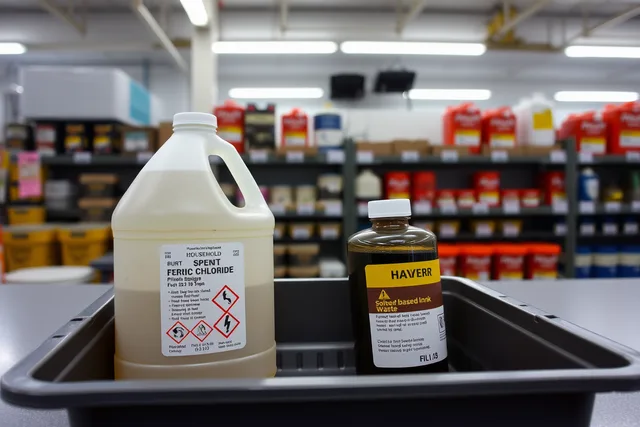
- Safety data sheets for inks or solvents travelling with the work.
DDP means your studio carries the duty and tax; DAP leaves both to the Canadian buyer. Brokerage and clearance fees land on whichever party clears the goods. Write the term on the invoice before the parcel leaves the studio, and keep the broker's name on file.
Solvents and ink additives move under different carrier rules, so check this guide to shipping printmaking chemistry to St. John's and northern Manitoba before packing a hazmat box for any Canadian address.